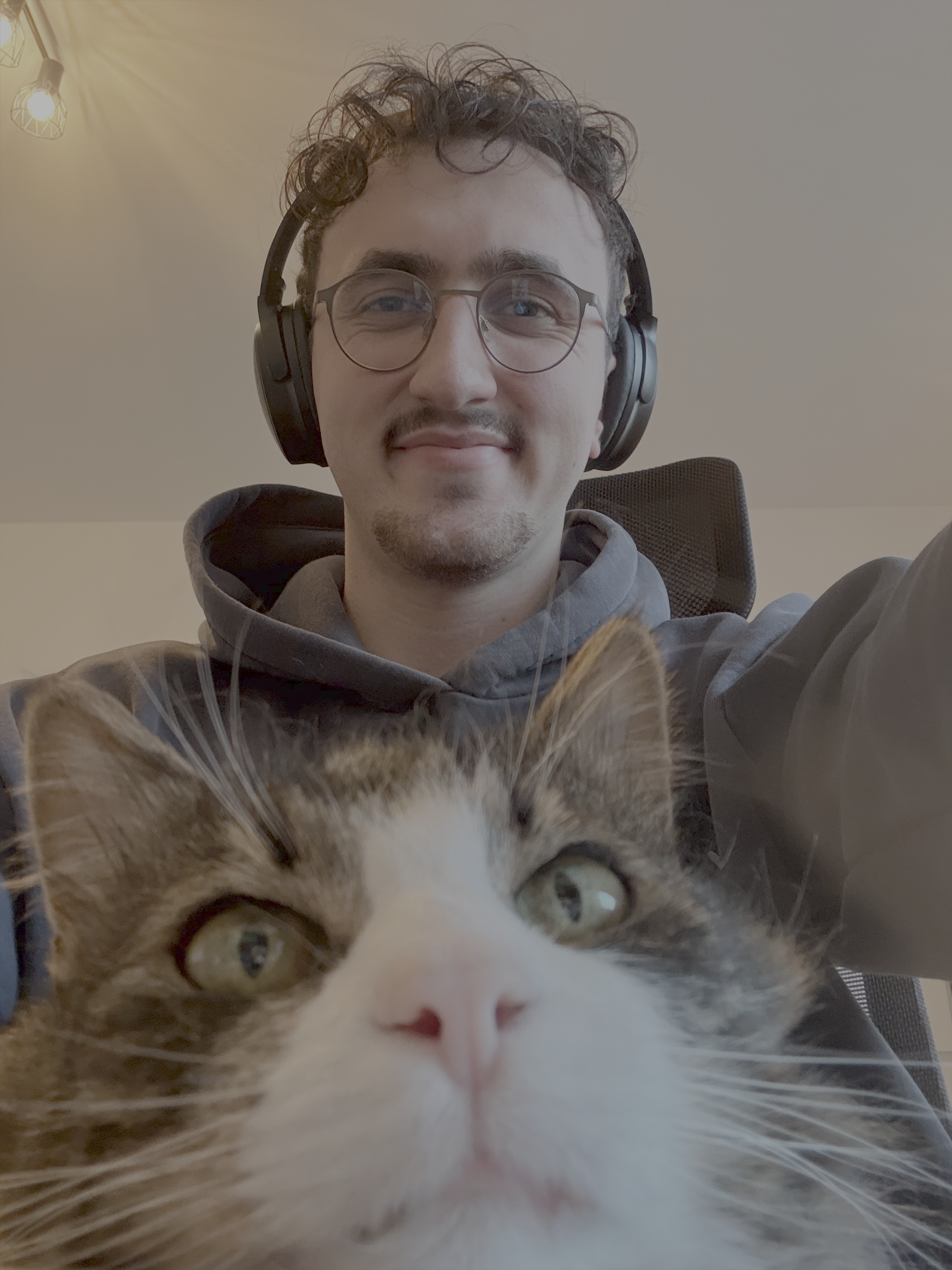
I'm a Software Engineer and AI Engineer at Mercedes-Benz Tech Innovation. The systems I build decide whether a dealer in South Korea, China or USA can configure the right car, whether a factory in Germany gets the correct build data or whether users across the whole globe can get informations about Mercedes-Benz new & used car portfolio.
Right now I'm deep in agentic AI. Not the "we fine-tuned a model in a Jupyter notebook" kind, but enterprise MCP servers running in production, agent systems with real users, and frameworks we built from scratch because nothing off the shelf was good enough. I designed the 3A Framework to help engineering teams adopt AI without losing their minds in the process.
Away from the keyboard: I ride a motorcycle, coach engineers on AI tooling, co-organize Vibathons, and talk to rooms of 200+ people about AI. Also: Alba Berlin breaks my heart every season... but not in 2026. WE WON! Also two cats have reviewed my code and found it acceptable.
Designing and building the central support agent for a car configuration support team, built on Mastra. We are starting small within one team. BUT once we prove the positive ROI, this agent will be published as a template across multiple software engineering teams in our domain. I run showcases for diverse audiences including Business Partners, Team Leads, Engineers, and Product Owners. The interest is high and people are actively pushing us to deliver. Modular connectors layer for plugging in data sources, persistent agent memory with built-in self-improvement loops, and A2A (Agent-to-Agent) protocol.
The single source of truth for Mercedes-Benz vehicle configuration data at enterprise scale. Serves dealer systems, the official website, car ordering workflows, and dozens of downstream background services across the whole world. We manage billions of requests per year and enable clean, unified data for all systems. We deliver billions of configuration permutations across the whole globe for everyone and make sure all cars are buildable based on multiple rule sets. From prices and buildability to technical details, we deliver it. Core responsibilities: data polishing and enrichment pipelines, caching architecture, and real-time API reliability under high load.
From a POC to a enterprise product supported and maintained by my whole team. Built and shipped one of the first officially approved and scalable Model Context Protocol servers inside Mercedes-Benz. What started this proof of concept in 2025 and now it's a fully end-to-end AI product, serving data globally to multiple products and teams. Token and cost efficiency is priority no. 1 and handled centrally, so consumers can enjoy our MCP without fear of hidden costs. Ownership covers clean architecture, coding, onboarding consumers, showcases, cloud infrastructure, and stakeholder management. Now enabling new AI products and AI agents to query live vehicle configuration data in real-time.
Designed and own a zero-risk production validation system that runs a new data source in parallel to legacy on every live API request, without ever touching the response. Differences are calculated in real-time, logged, and visualized on live dashboards. Fully configurable by market, vehicle model, and user segment. Real user traffic. Zero production risk. The system actively supports Mercedes-Benz software go-lives across multiple markets worldwide, and I am currently working on automating configuration adjustments based on the validation results.
My final project for my degree: a self-service platform, built as a plugin for the company's central internal developer platform, where teams across the organization create and manage webhooks for any internal service. Hooks plug directly into monitoring dashboards, so engineers and on-call teams receive incident alerts in whatever channel they prefer: ServiceNow, MS Teams, or Mattermost. Used by a large, cross-departmental user group. I focus on development and infrastructure, while showcases and onboarding sessions are run by colleagues I trained on the tooling, so we can scale it together across Mercedes-Benz.
Worked on a team predicting electric energy consumption for planned routes by fusing heterogeneous real-time signals: weather conditions, street topology, battery temperature, vehicle load, passenger weight, driving profile, and more. Every source adds precision, and the model collapses them into a single, actionable range estimate for the driver.
Built a feedback platform embedded across the central Mercedes-Benz Sales Platform, allowing any user to submit feedback, opinions, or suggestions directly from within any sub-app or page. The experience is seamless and consistent throughout the whole platform. Users can later revisit and review their submitted feedback. Product Owners get a dedicated admin dashboard to manage, filter, and analyse all incoming responses, including statistics and a built-in chat to follow up with feedback submitters directly.
AI is being used to manipulate people. Information gets withheld or deliberately framed. The motives can be political or corporate. Companies are increasingly trying to influence the training data of models to shape what they say. Ask a Chinese LLM and a US LLM who the best president is. You will get different answers.
Local LLMs are the future. You keep your data, your control, and your company knowledge to yourself instead of handing it to someone else. Lower latency, lower costs. Local LLMs will become significantly more relevant and widely used by early 2027.
AI is so insanely expensive that we should expect massive price hikes by mid 2026 at the latest. Companies will cancel subscriptions or heavily restrict usage. Token efficiency is not a nice-to-have anymore. Figure it out now before it hits you without preparation. Costs will explode and the pressure will rise to actually become more productive through AI or build something genuinely useful. Not just videos of Will Smith eating spaghetti.
Major AI companies will be forced to limit access due to politics or hardware constraints. Entire models could be shut down or made unavailable for specific nations. We should seriously consider running models ourselves to stay in control. Local LLMs are not a niche. They are the future. Update Jun 2026: Claude Fable 5 by Anthropic was taken offline on June 12 due to new US export controls. Back online worldwide July 1.
We are heading into serious security problems. LLMs are becoming capable enough to find and exploit zero-day vulnerabilities at scale. This has already started, but it will grow massively. We should be building automated pipeline loops that can detect and patch security issues before they are exploited. Preparation now, not reaction later.
Companies will race to make their data AI-ready. There will be a feverish push to provide perfect context for LLMs: for internal services, but mainly to get their own products discovered and promoted in AI chats on their own websites, Google Gemini search, and ChatGPT. AI visibility will become a central strategic focus.
A lot more people will produce code, and most of them won't know if it's good or bad. They will prompt and ship. People with zero engineering background will build things. Software development will get attention from every industry. The question is not whether they can build it. The question is what happens when it breaks. Update Mar 2026: All I see on LinkedIn and other major platforms is AI slop. I miss human content and authentic voices.
AI for developer tooling is overhyped and won't be used primarily in production. Tested GitHub Copilot extensively. Interesting for the first month, then it got in the way. Nice to have, not a fundamental shift. Update Nov 2025: I was wrong. We use it wherever it makes sense. It has become incredibly good and way better than expected.